


 English
 Français
What type of gloves do welders typically wear?
Of all industrial professions, welders are undoubtedly among those most frequently exposed to high temperatures, sparks, and strong radiation. Therefore, the choice of personal protective equipment (PPE) is crucial for them, and a reliable pair of welding gloves is paramount. A high-quality pair of welding gloves not only protects hands from burns but also provides the flexibility needed to operate the welding torch and electrodes.
Content
Why are specialized welding gloves needed?
Ordinary work gloves cannot withstand the extreme conditions generated during welding. Welding gloves are special because they must meet several key requirements:
- High temperature resistance and fire resistance: The arc temperature generated during welding is extremely high, and the temperature of the spatter (weld slag) can reach hundreds of degrees Celsius.
- Resistance to mechanical damage: Protecting hands from sharp metal edges, abrasion, and impact.
- Electrical insulation: In some arc welding operations (such as electric welding), a certain level of electrical protection is required.
- Comfort and flexibility: Welders need to maintain precise control over hand tools.
The Welder's "Second Skin": Common Welding Glove Materials
The choice of welding gloves depends primarily on the welding process and working environment. The most common welding gloves on the market are typically made of the following leathers:
Cowhide:
Suitable for: Mixed welding, such as MIG/MAG welding (gas shielded welding) and heavy-duty operations.
Key characteristics: High durability and abrasion resistance; typically used to make thick welding gloves, offering good cost-effectiveness.
Goatskin:
Suitable for: Precision welding, especially TIG welding (tungsten inert gas welding).
Key characteristics: Thinner and softer leather, providing welders with superior feel and flexibility, making it the preferred choice for delicate operations.
Pigskin:
Suitable for: Mixed welding environments.
Key characteristics: Good flexibility; a significant advantage is that it does not easily harden even when wet or soaked.
Deerskin:
Suitable for: High-end applications or long-duration work requiring exceptional comfort.
Key Features: Extremely soft and comfortable, one of the best-feeling materials among all leathers.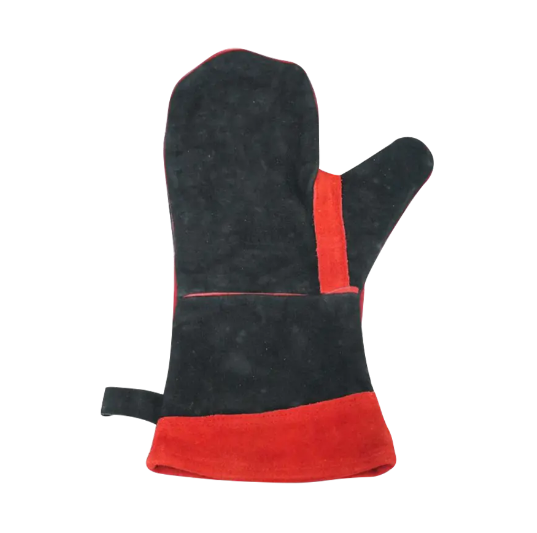
Glove Requirements for Different Welding Processes
MIG/MAG Welding (Gas Shielded Welding) and SMAW Welding (Manual Arc Welding):
These types of welding produce a large amount of high-temperature spatter, thus requiring thicker, longer, heavy-duty welding gloves, typically made of thick cowhide.
TIG Welding (Tungsten Inert Gas Welding):
TIG welding is precise, with less spatter but concentrated heat. Welders need extremely high finger dexterity and tactile feedback for precise wire feeding.
Therefore, TIG welding gloves are typically made of soft goatskin or deerskin, with a thinner palm area, but the glove sleeve is still long enough to protect the forearm.
How to Choose the Most Suitable Protective Gloves for Welders?
To ensure safety and efficiency, welders should consider the following when selecting welding gloves:
- Choose the correct leather type: Match the type of welding (thick cowhide vs. thin goatskin).
- Check the stitching: High-quality gloves should be sewn with fire-resistant Kevlar thread to ensure they won't crack at high temperatures.
- Size and fit: Gloves must fit well; too loose or too tight will affect operational safety and comfort.
Welding gloves are not just protective tools, but essential partners for welders to perform high-quality work. Selecting the most suitable professional gloves based on the specific welding process is crucial to maximizing operator safety and work efficiency.
 +86-0513-68163373
Product Category
Related Products
If you are interested in our products, please consult us
Contact Details
- Address: No.99 West Dingxin Road, Dingyan Town, Rugao, Jiangsu, 226500, China
- Fax: +86-0513-88568360
- Tel: +86-0513-68163373
- Email: [email protected]
[email protected]
Products
Quick Link
News Center
Mobile terminal
