


 English
 Français
News
Home / News / Industry News / What Kind of Gloves Are Best for Handling Chemicals? A Two-Layer Safety Guide

A 25-litre drum of caustic soda, a plastic jug, and a pair of gloves that had been sitting in a warehouse cupboard since last winter. Fifteen seconds into the pour, the operator felt the first sting across his knuckles. The gloves had not torn. They had not been cut. They looked perfectly fine afterwards. That is the awkward thing about chemical exposure: the damage usually starts well before the material shows any visible failure.
So here is the short answer before the detail. There is no single glove that is best for handling chemicals. The right glove is decided by the chemical itself, by how long and how often skin contact happens, and by whatever else the job demands from the hands. For a large share of industrial tasks, the workable answer is a two-layer system: a thin chemical-resistant liner chosen from permeation data, plus an outer leather glove that provides grip, abrasion resistance, impact protection and insulation. Manufacturers such as Nantong Qiji Glove Co., Ltd. build that outer layer, and getting the two layers to work together is what this article is about.
Content
Before anyone starts comparing materials, it is worth fixing the question. The useful question is not "which glove is the best glove" but "which glove is right for this chemical, at this concentration, at this temperature, for this long, while I also do these other things with my hands".
Three factors decide the answer, and they are decided in this order:
In most real workplaces, a single layer cannot satisfy all three at once. A liner thin enough to give good feel is usually too slippery and too fragile to lift a wet drum. A heavy glove that grips a wet drum well is usually a poor chemical barrier. That is why layering has become standard practice rather than a compromise.
The outer layer is where leather earns its place. It carries the grip, the abrasion resistance, the heat insulation and the impact protection. What leather does not do is act as a chemical barrier, and no honest manufacturer will tell you otherwise.
These three terms get used interchangeably in purchasing conversations, and that causes a lot of bad glove decisions.
Penetration is the physical movement of a liquid through a hole, a pinhole, a seam gap or a defect. It happens immediately and it is visible if you look closely. This is why glove integrity at the point of use matters more than the headline specification on the box.
Degradation is a change in the material itself after contact with the chemical. The glove may stiffen, soften, swell or crack. Leather is a good example here: it absorbs water and oils, and once it dries out it can harden and lose the suppleness that made it comfortable. A degraded glove may still look intact while its protection has already gone.
Permeation is the one that catches people out. Chemical molecules travel through the material at a molecular level. There is no hole, no drip, no visible warning. There is simply a breakthrough time, measured in minutes, after which the chemical has reached the inside surface of the glove. Some materials hold out for eight hours against a given chemical; others manage twenty minutes.
This is why the correct order of selection is: check integrity first, check material compatibility second, and check breakthrough time third. Breakthrough time is not a question of whether the chemical will pass through, only of when.
Polymer chemistry is the reason the same glove that is excellent against one solvent is useless against another. The comparison below is a rough orientation only, because real performance shifts enormously with concentration, temperature and the exact chemical involved.
The chart shows a generalised rating for chemical permeation resistance across common glove materials, scored from one to five. It is meant to help a buyer see the broad shape of the market before opening the technical data.
Butyl and nitrile sit at the top of this comparison because they cover a wide spread of oils, greases and industrial solvents, which is why they dominate single-use liners. PVA handles aromatic and chlorinated solvents that break down other materials, but it dissolves in water, so it is a specialist choice rather than a general one. Neoprene is the workhorse for fuel, oil and mild acid exposure, and PVC is a low-cost option that is reasonable for water-based liquids and weak acids but poor with solvents.
For a glove maker building outer layers, this chart has one practical consequence. The outer glove is chosen for the mechanical job, and the inner glove is chosen from a chart like this one. The two decisions should never be merged into a single purchase line.
| Material | Typical chemical fit | Dexterity | Mechanical protection | Where it earns its keep |
|---|---|---|---|---|
| Nitrile rubber | Oils, greases, many solvents; poor against ketones and strong acids | High | Low to medium | Disposable liners, laboratory work, short decanting tasks |
| Neoprene | Oils, fuels, acids, alkalis; broadly useful | Medium | Medium | Drum handling, light maintenance, jobs needing durability |
| Butyl rubber | Ketones, esters, strong alkalis; higher cost | Medium | Low | High-value solvents, extended contact time |
| PVC | Water-based chemicals, dilute acids; poor with solvents | Medium | Low | Low-cost splash protection |
| PVA | Aromatic and chlorinated solvents; dissolves in water | Medium | Low | Dry-environment solvent work |
| Cowhide or goatskin leather | Limited barrier against permeation; water and oil resistant treatments slow surface absorption | Medium | High | Mechanical outer layer: grip, abrasion, impact, heat |
| PU microfiber synthetic | Limited barrier against permeation | High | Medium | Dexterous handling, lightly oiled surfaces |
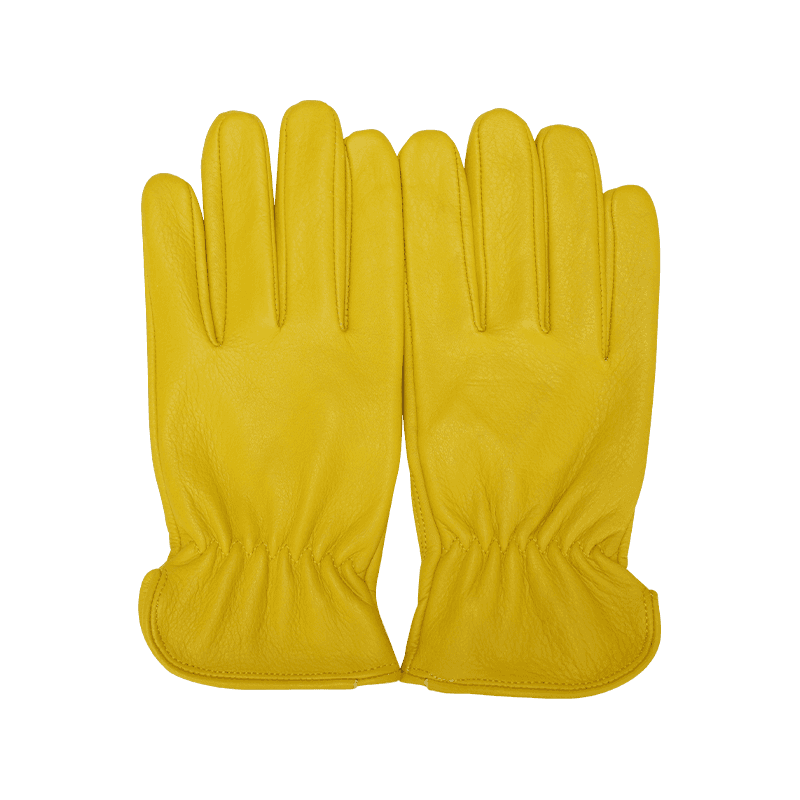
Leather is not a barrier material, and treating it as one is how people get hurt. What leather does extremely well is everything that happens around the chemical risk: gripping a wet drum, resisting abrasion on rough steel, absorbing the shock of a dropped container, and insulating the hand from hot pipework.
Surface treatments change the practical picture a little. Water-repellent and oil-resistant finishes slow the absorption of liquids into the leather surface, which keeps the glove lighter, keeps grip more predictable, and makes the glove easier to wipe down between tasks. That is a meaningful improvement for a maintenance team working around oil, coolant and dilute chemical splash, even though it does not turn leather into a chemical barrier.
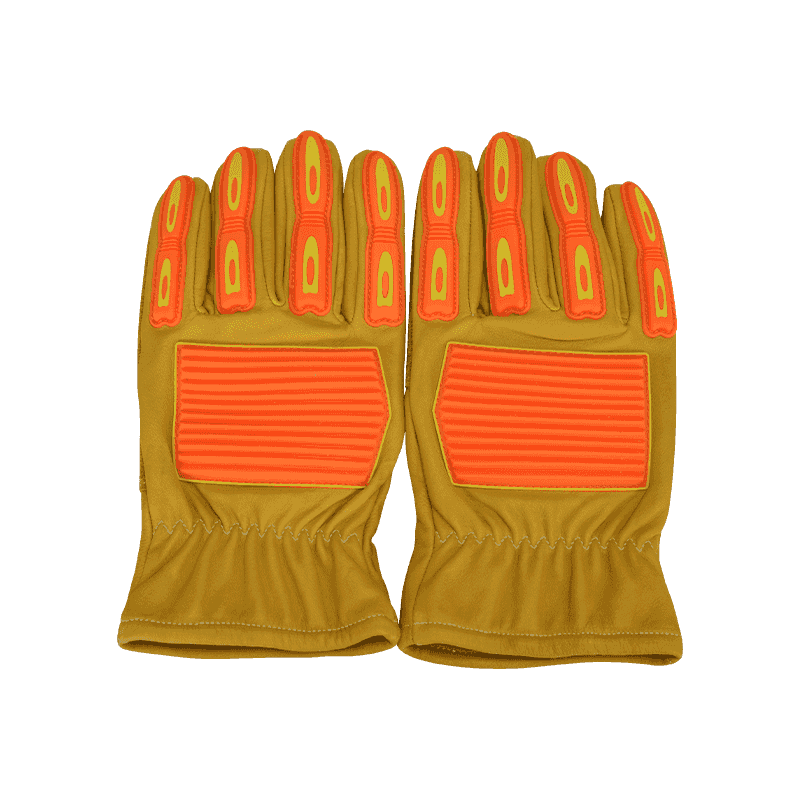 Waterproof Oil Resistant Flam Retardant Anti-impact Cowhide GlovesThe high-performance protective gloves adopt advanced material production technology and precise processing technology and realize the organic combination of various p...View Product →
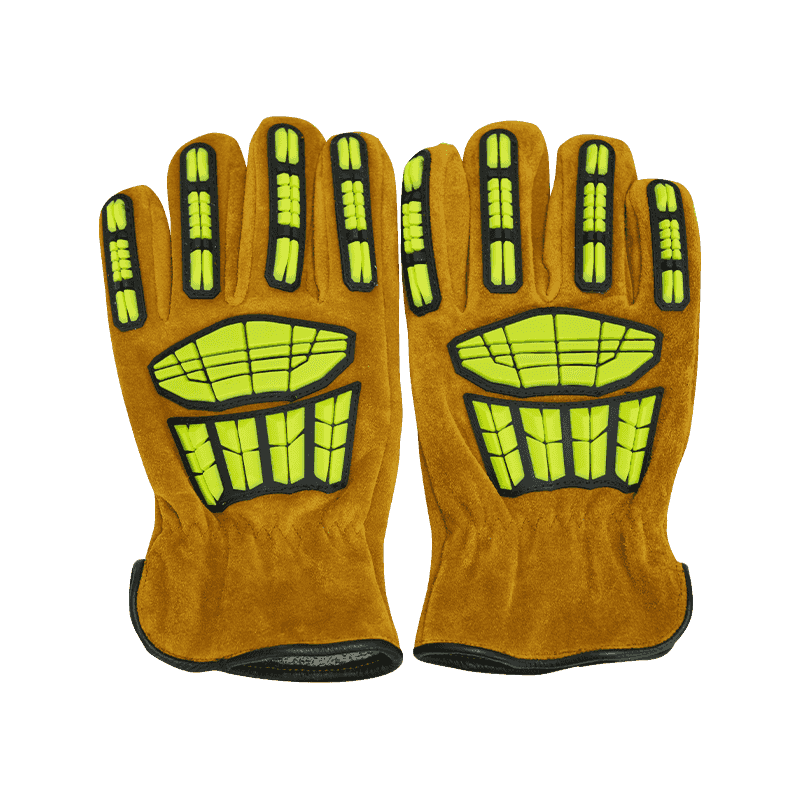 Waterproof Oil Resistant Cold Resistnt Cowhide Leather GlovesWaterproof, oil-proof, and cold-proof cowhide gloves are made of high-quality cowhide leather, combined with advanced production technology to achieve three major func...View Product →
Two examples from the range make the point. The waterproof, oil-resistant, flame-retardant, impact-resistant cowhide glove combines four properties that rarely appear together: it shrugs off oil and water on the surface, resists brief flame contact, and uses an impact-resistant back for knuckle protection. The waterproof, oil-resistant, cold-resistant cowhide glove takes the same logic into cold stores and winter outdoor work, where a chemical liner alone would leave the hands too cold to work safely.
One sizing detail matters more than most people expect. The outer leather glove should be half a size to one size larger than the liner worn underneath it. If the outer layer is too tight, it rolls the liner at the fingertips, cuts off circulation, and creates exactly the kind of fatigue that leads to a dropped container.
Theory is useful, but most buying decisions are made against a specific job. The five situations below cover the majority of enquiries that reach a glove manufacturer.
Notice how often the outer layer is doing the same three jobs: grip, impact and insulation. That repetition is the reason a glove manufacturer can serve a wide range of chemical-adjacent industries with a comparatively focused leather outer range.
A specification that simply says "chemical gloves" is not a specification. It is an instruction to buy whatever the supplier has on the shelf. The list below is the minimum information a glove supplier needs to quote accurately and consistently.
For buyers working with an overseas manufacturer, adding packaging and labelling requirements to the same document avoids a second round of emails later. It also makes quotations comparable, which is where most of the real cost savings are found.
Most glove failures in chemical environments are purchasing failures rather than manufacturing failures. These are the patterns that show up again and again.
Each of these mistakes tends to appear after a change of supplier, which is why a structured re-evaluation period of two to four weeks is worth building into any new glove programme.
For importers, distributors and industrial buyers, the supplier question is a different question from the glove question. A supplier with a narrow product range can be excellent, but it will force you to run several purchase orders where one would do. A supplier with a broad leather range, consistent sizing and the ability to develop a custom specification is usually worth a slightly higher unit price.
When evaluating a safety work gloves manufacturer or wholesaler, look at four things. First, whether the range covers the functions you actually need rather than a long catalogue of near-identical items. Second, whether sizing and materials stay consistent between batches. Third, whether the supplier can talk about stitching, cuff construction and finish in specific terms. Fourth, whether they can support OEM development rather than only shipping from stock.
It also helps to read how a manufacturer thinks about the design problems behind the product. An article on functional gloves designed to reduce hand fatigue tells you more about a factory's engineering culture than a specification sheet does.
 Water Repellent Arc Protection Anti-impact cowhide GlovesThe splash-proof, arc-proof, shock-absorbing cowhide glove is a professional protective glove designed for electric power, chemical, machinery, and other industries. I...View Product →
There is a further practical consideration for anyone buying in volume. Leather outer gloves for chemical-adjacent work need to combine a water-repellent and oil-resistant finish with impact protection and, in some cases, arc or flame resistance. A manufacturer that already produces the waterproof, arc-protection, impact-resistant cowhide glove alongside cold-resistant and flame-retardant variants is likely to have the tooling and the pattern library to adjust a specification without starting from scratch.
Leather should not be used as the primary barrier against solvents. It can be worn as an outer layer over a solvent-resistant liner when the task also involves heat, abrasion or impact. Confirm the liner against the specific solvent before use.
Thickness is only one variable. A thin nitrile liner can outperform a much thicker glove of the wrong material. Choose by material compatibility and breakthrough time first, then use thickness to fine-tune durability and dexterity.
Reusable liners can often be rinsed and inspected, provided they are still within their rated breakthrough time and show no swelling, hardening or discolouration. Single-use liners should be discarded after contact. When in doubt, replace.
Yes, and this is common practice in maintenance and drum handling. The outer glove should be half a size to one size larger than the liner so that the liner does not roll at the fingertips.
A water-repellent and oil-resistant leather glove will resist light surface splash and can be wiped down, which reduces absorption between tasks. It is not a barrier against prolonged or repeated chemical contact, so pair it with an appropriate liner.
Check three things: visible damage or stiffness, the time the glove has been worn in contact with the chemical, and the condition of the liner inside. Permeation gives no visible warning, so tracking contact time is the most reliable habit.
Handling chemicals safely with gloves comes down to two lists written side by side. The first list is chemical: what it is, how concentrated, how warm, how long the contact lasts, and how quickly it moves through a given material. The second list is physical: what has to be gripped, cut, lifted, insulated or absorbed in the course of the shift. When those two lists are kept apart, the glove choice usually becomes obvious, and it is almost always a combination rather than a single glove.
For buyers running that evaluation across several sites or several product lines, the fastest route is to send both lists to a manufacturer that already builds the mechanical outer layer in the exact functions required. That is where a focused leather glove range, backed by consistent sizing and batch control, saves more time than a long catalogue of look-alike products ever will.
If you are interested in our products, please consult us
 +86-0513-68163373
