


 English
 Français
News
Home / News / Industry News / Impact Resistant Gloves: Grades, Materials and Sourcing Guide for Buyers

A press operator at a metal stamping line reaches in to clear a jam. The die closes. His glove takes the hit, and the difference between a bruised hand and a broken one comes down to a few millimetres of thermoplastic rubber sitting over his knuckles. That is the entire job of impact resistant gloves. They are not cut-resistant gloves with a tougher-sounding name, and they are not general-purpose leather work gloves with a bit of padding glued on.
Here is the short answer first. If your workers face falling tools, swinging components, pinch points or repeated knocks against hard edges, specify gloves with a tested impact rating, either ANSI/ISEA 138 Performance Level 1, 2 or 3, or the impact pictogram under EN 388:2016. If their exposure is abrasion and light cutting only, an impact-rated glove is almost certainly the wrong specification, and you will pay for padding that never earns its keep.
The rest of this page covers what those ratings actually measure, how leather and synthetic constructions differ in the field, which combinations handle the messy jobs where impact, cut, oil, water, cold and heat arrive together, and what importers, wholesalers and distributors should verify before releasing a bulk purchase order.
Content
Impact is a short, high-energy load. A dropped wrench, a swinging steel plate, a recoiling tool, a pinch point on a conveyor or a hand pressed against a sharp edge during assembly all deliver force over a very short window. The glove's job is to spread that force across a wider area and stretch the time over which the hand absorbs it, which lowers the peak pressure at any single point on the hand.
Cut resistance works differently. Cutting injuries come from a blade or sharp edge sliding across the material under pressure. Cut performance is about how much load a blade needs to sever the material, which is why cut-resistant gloves rely on high-tenacity yarns, aramid blends or tightly woven leather rather than on hard plastic shells.
This distinction matters commercially. A buyer who orders an impact glove to solve a cut problem will end up with a heavier, less dexterous product that still fails the cut test. A buyer who orders a thin cut glove to solve an impact problem will get a product that tears open within a week of regular use.
No glove on the market prevents a crushing injury from a hydraulic press or a slow-moving heavy roller. Impact ratings address a single dynamic blow at a defined energy level, not sustained compression. Impact gloves also provide no electrical insulation unless they carry a specific arc-flash or dielectric rating, and they offer no chemical permeation protection. Where those hazards exist, the impact glove has to sit inside a wider PPE programme rather than replace it.
Two standards dominate procurement specifications: ANSI/ISEA 138 in North America and EN 388:2016 in Europe. They are not interchangeable, and a specification that lists one without the other will often fail at customs clearance or at the customer's incoming inspection.
The test drops a known mass onto a glove sample resting on a domed anvil, with a force sensor underneath. Four knuckle positions and the thumb are tested across multiple samples. The result is reported as peak transmitted force in kilonewtons, and the final rating reflects the worst-performing sample, not the average.
The three levels are defined by upper thresholds:
| Performance level | Maximum peak transmitted force | Typical field interpretation |
|---|---|---|
| Level 1 | 9.0 kN | Basic knuckle protection for light assembly and handling |
| Level 2 | 6.5 kN | General industrial use, maintenance, tool handling |
| Level 3 | 4.5 kN | Heavy fabrication, foundry work, high-energy manual tasks |
Buyers should note that the level is set by the weakest of the tested positions. A glove that performs well at the knuckles but poorly at the thumb will be graded on the thumb. This is why a factory that only checks the back of the hand in-house will produce samples that fail third-party verification.
EN 388 covers abrasion, cut, tear and puncture, and the 2016 revision added a TDM cut test for higher-performance materials plus a separate impact test. Under the current version, a glove that passes the impact test receives the letter P beneath the shield pictogram. It is a pass or fail result, not a graded scale.
The practical consequence is that a European customer asking for "EN 388 impact" is asking for a yes or no, while a North American customer asking for "ANSI level 2" is asking for a specific performance band. Suppliers who can hold both sets of documentation at once are considerably easier to work with than those who can only produce one.
The gap between levels is smaller than most procurement teams assume when they first see the numbers on a specification sheet. The chart below plots the permitted transmitted force at each ANSI/ISEA 138 level on a common scale so the differences are visible side by side.
Maximum permitted peak transmitted force by ANSI/ISEA 138 level (kN)
Lower transmitted force indicates greater protection. All bars drawn to a common scale.
What the chart makes clear is that moving from Level 1 to Level 3 requires the glove to absorb roughly half the force that a Level 1 product is permitted to pass through. That reduction is achieved mainly by armour thickness, material density and the number of independent segments in the back-of-hand shell, all of which add weight and reduce flexibility.
It also explains why Level 2 has become the working default across general industry. The step from Level 1 to Level 2 delivers a meaningful reduction in transmitted force for a modest increase in bulk, while the step from Level 2 to Level 3 usually pushes gloves into a weight category that workers find tiring to wear across a full shift.
For procurement teams, the practical reading is that the specification should follow the measured hazard rather than the highest number available in the catalogue. An operation that specifies Level 3 across every workstation will often see compliance fall and glove consumption rise, because workers remove heavy gloves at the first opportunity and put them back on far less often.
Impact gloves on the current market fall into three broad construction families. The right family depends on how much dexterity the task demands and how many other hazards share the same workspace.
This is the dominant design in metal fabrication, automotive assembly and general maintenance. A full-grain or split cowhide palm handles abrasion and grip while a moulded TPR shell covers the knuckles and the back of the hand. The shell is usually segmented so the fingers can still flex. Quality differences show up in the hardness of the TPR compound, the thickness of the individual segments and whether the shell is stitched to a separate liner or bonded directly onto the leather.
A common failure mode in cheap versions is delamination at the finger joints after a few weeks of use. That is usually a bonding or stitching problem rather than a material problem, and it is worth asking a supplier how the shell is attached before placing a volume order.
Microfiber synthetic leather offers consistent thickness from batch to batch, resists oil absorption better than natural leather in some formulations and can be washed more aggressively. The trade-off is that it generally delivers lower cut performance and less natural grip on oily or wet surfaces. For environments where hygiene and repeatable thickness matter more than cut protection, synthetic builds are a reasonable choice.
Many industrial jobs involve impact plus something else, and the market has responded with composite designs. A single glove may carry water repellency, oil resistance, flame retardancy, cold insulation and arc protection alongside the impact rating. These products are built by combining a treated leather outer, an internal membrane or coating, and a lined back-of-hand shell.
Composite construction is where supplier capability separates quickly. Adding a second or third function changes the tanning, the finishing and the assembly sequence, and it is relatively easy to lose impact performance while chasing water resistance or thermal insulation. Buyers evaluating a composite glove should ask for the full test report on the finished product rather than a report on the leather on its own.
Palm material drives abrasion life, grip, cost and how the glove actually feels after four hours of wear. The table below compares the options most often quoted by leather work glove manufacturers.
| Material | Abrasion life | Grip on oily surfaces | Dexterity | Relative cost | Common applications |
|---|---|---|---|---|---|
| Full-grain cowhide | High | Good | Moderate | Medium | Fabrication, welding, heavy handling |
| Split cowhide | Medium to high | Moderate | Moderate | Low to medium | General labour, construction, logistics |
| Goatskin | Medium | Very good | High | Medium to high | Precision assembly, driving, gardening |
| Sheepskin | Low to medium | Good | Very high | Medium | Light assembly, cold conditions, comfort-first roles |
| Synthetic microfiber | Medium | Moderate | High | Low to medium | High-volume consumable programmes, washable environments |
Cowhide remains the volume choice for heavy industrial work. Full-grain cowhide keeps its structure longer under abrasion and resists tearing at the palm, which is why it appears so often in welding and fabrication lines. Split cowhide costs less but offers a shorter service life, and it is best treated as a consumable item in high-turnover operations.
Goatskin is the material to reach for when grip quality matters more than raw abrasion life. Its tighter fibre structure gives better feel on small components and improved control on slippery surfaces, which is why it shows up in precision assembly, driving and gardening rather than in heavy stamping. Sheepskin delivers the highest dexterity of the natural options but the lowest abrasion resistance, so it belongs in roles where the glove is more about comfort and light protection than about surviving constant contact with rough steel.
Synthetic microfiber occupies the volume-consumable position. It offers excellent thickness consistency and works well in laundering programmes, but the lower cut performance means it should not be used as a substitute where sharp edges are present.
Impact rarely travels alone in an industrial setting. The sections below walk through the four environments where specification errors cost the most, and where the difference between a single-function and a composite glove becomes visible within a month.
This is the classic impact environment: sharp sheet edges, heavy tools, swinging parts and constant handling of rigid components. A Level 2 back-of-hand shell combined with a cut-resistant palm covers the majority of these tasks. Watch the fit around the finger crotch, because the armour segments have to flex with the hand without opening a gap that lets a sheet edge slip under the shell.
Where oil mist, coolant spray or hydraulic fluid is present, the palm will harden and lose grip unless the leather is treated. A treated cowhide with a cut-resistant liner and a Level 2 impact shell handles the combined load without forcing a second glove change during the shift.
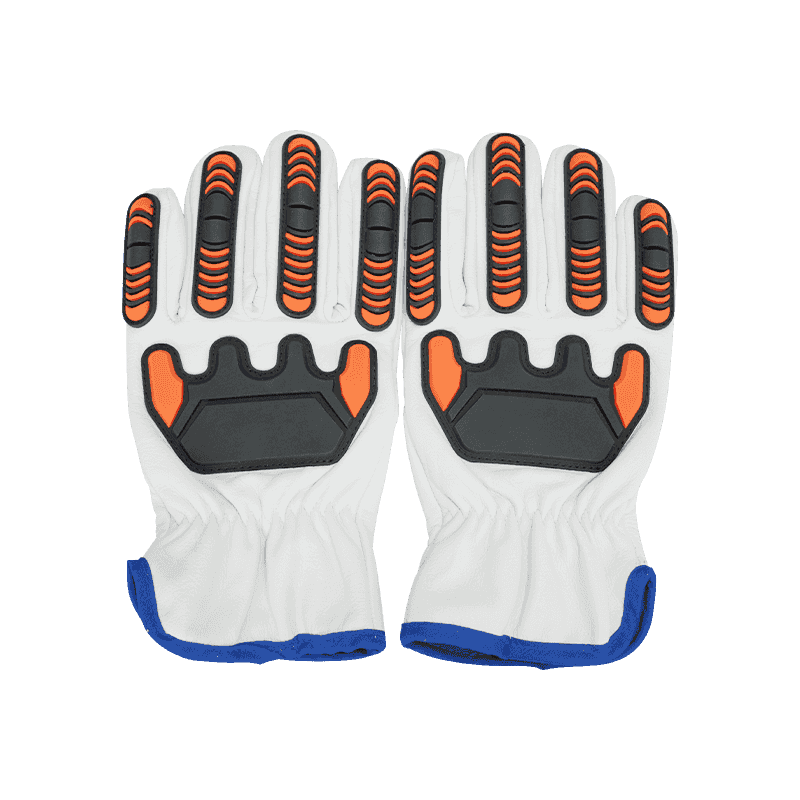 Anti-impact Cut-resistant Cowhide Leather Gloves1. These gloves are made of high-quality cowhide leather, which is known for its desirable abrasion resistance, tear resistance, and flexibility, and can effectively r...View Product →
Heat and impact overlap more often than most safety programmes assume. Welders handle hot metal, drop heavy fixtures and work near sharp edges, and a glove that protects only against sparks will not survive contact with the workpiece. Longer cuffs, heavier leather and flame-retardant treatment all matter, and the impact shell has to be positioned so it does not trap heat against the back of the hand.
For TIG and precision welding, dexterity is the limiting factor, and the impact shell needs to be thin enough that the welder can still control the filler rod. For heavier manual metal arc work, a longer cuff and thicker leather give better protection against spatter travelling up the forearm.
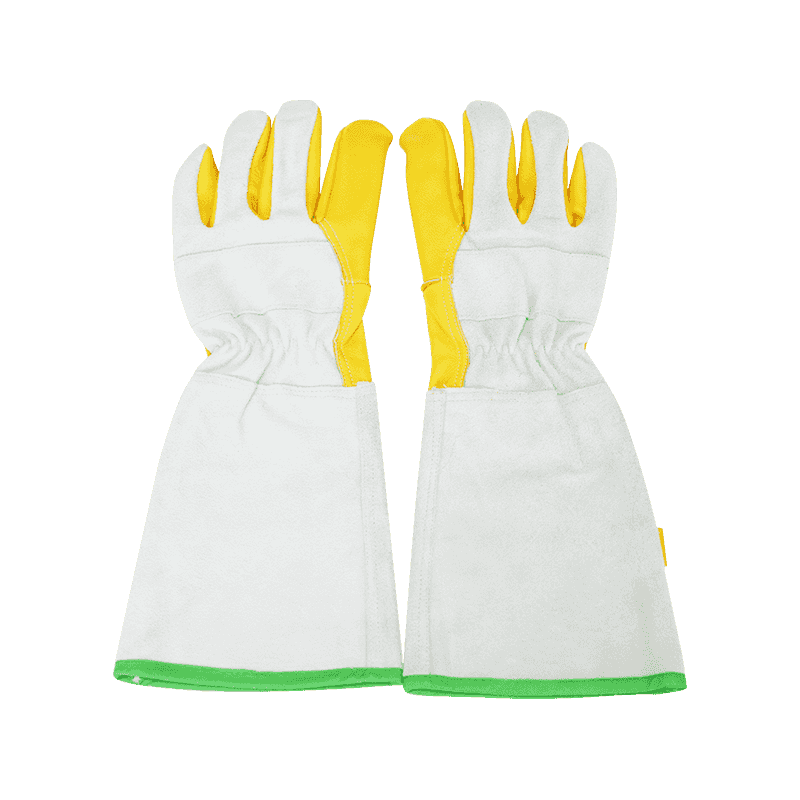 Lengthened Cowhide Leather Welding Gloves1. The desirable performance of cowhide welding gloves ensures the safety of workers during welding operations. It can withstand high temperatures, sparks, and spatter...View Product →
Wet and oily surfaces are where most impact specifications quietly fail. Untreated leather absorbs water, softens and loses both grip and structural integrity, and an oil-saturated palm loses friction precisely when the worker needs it most. For these conditions, look for treated leather with water and oil repellency, plus flame retardancy where arc exposure is possible.
It is worth noting that water repellency and water resistance are not the same property. A repellent finish sheds spray and light contact; a membrane-backed construction blocks sustained saturation. The difference matters when the glove is worn through a full wet shift rather than through occasional splash exposure.
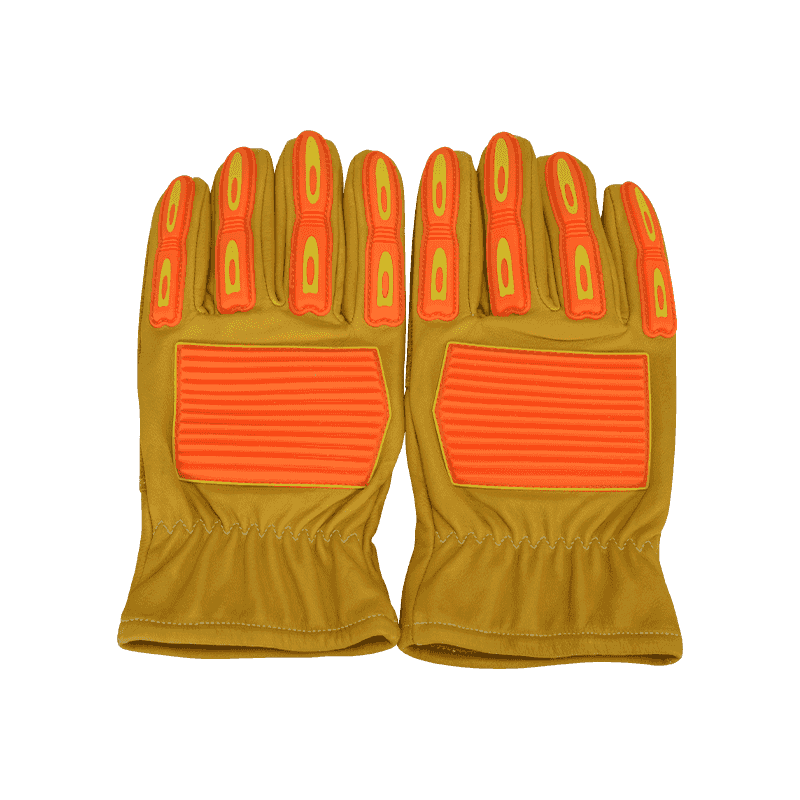 Waterproof Oil Resistant Flam Retardant Anti-impact Cowhide GlovesThe high-performance protective gloves adopt advanced material production technology and precise processing technology and realize the organic combination of various p...View Product →
Cold environments change the way impact armour behaves. Thermoplastic rubber stiffens at low temperature, which reduces flexibility and can make the shell feel brittle. A glove designed for cold rooms needs both an insulating liner and an armour compound selected for low-temperature flex, otherwise the protection degrades exactly when the worker's reaction time is already slower.
The practical specification combines impact protection, cut protection and cold insulation in one product, which is why composite designs have grown in cold-chain logistics and winter construction work.
Once the technical specification is settled, the sourcing conversation turns to consistency, documentation and lead time. These are the points where a purchase order either runs smoothly or generates a year of returns.
Order samples from at least three production runs rather than one. Impact performance depends partly on the armour compound and partly on the assembly, and small shifts in bonding pressure or stitch tension can move a glove between levels. A supplier who can demonstrate stable results across three consecutive runs is a materially lower risk than one who can only show a single golden sample.
Most leather work glove manufacturers offer OEM and ODM programmes covering palm material, cuff length, armour configuration, colour, branding and packaging. The trade-offs are familiar: custom colourways and bespoke shell geometry increase minimum order quantities and extend development time, while standard specifications ship faster and cost less per pair.
For distributors building a private-label range, it usually makes sense to start with one or two standard constructions and customise branding and packaging only. Once the product is moving and the specification has been validated in the field, deeper customisation becomes far easier to justify.
Impact gloves fail in the field for reasons that have nothing to do with the rating on the label. They get removed because they are too hot, too stiff, or the wrong size, and once that habit forms it is very hard to reverse.
Glove sizing is usually based on palm circumference measured around the knuckles, with hand length used as a secondary check. A worker who measures at the boundary between two sizes should generally take the larger size for an impact glove, because the armour reduces the available stretch across the back of the hand. A glove that is too small will pull the shell tight across the knuckles and reduce protection rather than improve it.
Back-of-hand armour traps heat. In warm workshops this leads to sweating, which softens the leather from the inside and accelerates wear. Breathable liners, perforated shell segments and moisture-wicking linings all help, and where they are not available, rotating two pairs per worker across a shift often works better than switching to a lighter specification.
Assembly work involving small fasteners typically needs a glove that lets the worker pick up a nut or a bolt without removing it. If the impact shell prevents that, workers will pull the glove off for the fine work and put it back on for the heavy work, which defeats the purpose. In those roles, a lighter Level 1 shell with a thin goatskin palm is often more effective than a heavier Level 3 product that nobody keeps on.
Impact gloves degrade in ways that are easy to miss. The armour can remain visually intact while the attachment points underneath have already failed, which means a glove can look serviceable right up to the moment it comes apart under load.
Leather gloves should be cleaned according to the manufacturer's instructions, usually with a damp cloth and mild soap rather than solvent. Solvents strip the natural oils from the leather and accelerate cracking. Drying should happen at room temperature away from direct heat, because high-temperature drying hardens both the leather and the thermoplastic armour. Synthetic microfiber gloves are more tolerant of laundering but should still be dried away from direct heat sources.
Replacement should be triggered by any of the following: visible separation between the shell and the leather, cracks that run through more than one armour segment, palm leather worn through to the liner, or a cuff that no longer holds. A useful rule for distributors and safety managers is to record how many shifts a pair survives under normal use, then set the replacement interval slightly below that figure rather than waiting for a formal failure.
They describe how much force is permitted to pass through the glove during a controlled impact test. Level 1 allows up to 9.0 kN, Level 2 up to 6.5 kN and Level 3 up to 4.5 kN. Lower is better, and the rating is set by the worst-performing tested position.
No. Impact gloves are built to absorb a dynamic blow, usually through a moulded shell on the back of the hand. Cut-resistant gloves are built to resist a blade or sharp edge. Some products carry both ratings, but the two properties are tested separately and should be specified separately.
Only if the glove carries a specific arc-flash or dielectric rating. Standard impact armour provides no electrical insulation. Where arc exposure exists, the impact layer typically sits inside a rated system rather than acting as the primary electrical barrier.
Full-grain cowhide generally delivers the longest abrasion life among the common options, followed by split cowhide and then goatskin. Synthetic microfiber sits in the middle for abrasion but offers better batch-to-batch consistency. The right answer still depends on the dominant hazard in the task.
A practical approach is three pairs per candidate model, drawn from different production runs where possible. This gives enough data to compare fit, dexterity and early wear across operators without committing to a full container volume.
The armour compound itself does not usually change dramatically, but the attachment between the shell and the glove body does. Once segments start lifting or the stitching fails, effective protection drops even though the material looks intact. That is why inspection should focus on attachment rather than on appearance alone.
Confirm that the pictograms and performance levels printed on the packaging match the current test report, that sizes are clearly marked, and that any care instructions match what the material can withstand. Mismatches between packaging claims and test documentation are one of the most common reasons shipments get rejected at the receiving dock.
Most experienced manufacturers offer OEM and ODM programmes covering palm material, shell configuration, colour, branding and packaging. Custom shell geometry and bespoke colourways usually raise minimum order quantities, while branding and packaging changes are typically easier to accommodate at lower volumes.
For a deeper look at how cut performance is established in leather work gloves, see our technical note on what determines the cut resistance of cut-resistant cowhide leather gloves. If hand fatigue is a recurring complaint on your lines, the discussion of how functional gloves reduce hand fatigue and improve work efficiency covers the design factors that matter most.

If you are interested in our products, please consult us
 +86-0513-68163373