


 English
 Français
How to choose welding gloves more safely?
Choosing safer welding gloves depends on “protection level matching the working conditions, high-temperature-resistant materials, splash-proof structure, and compliance with safety standards.” Only by scientifically selecting gloves according to the type of welding operation (arc welding, TIG welding, gas-shielded welding, cutting operations, etc.) can welding gloves truly provide safety protection against burns, spark splashes, cuts, and arc burns, rather than only providing superficial “thermal insulation” protection.
Content
Core safety protection functions of welding gloves
High-quality welding gloves should simultaneously have the following protective capabilities: High-temperature protection: resist welding slag, sparks, and molten droplet splashes
Thermal insulation performance: reduce high-temperature conduction injuries
Cut resistance and wear resistance: prevent injuries from sharp metal edges
Fire resistance and flame retardancy: prevent material combustion
Arc protection: reduce the risk of arc burns
Operational flexibility: ensure control for precision welding operations
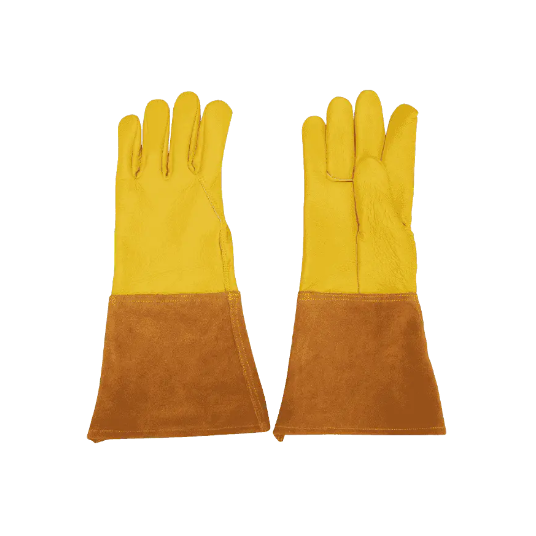
Welding glove materials are the core foundation of safety
Genuine leather welding gloves
Common types: cowhide welding gloves, sheepskin welding gloves, split leather welding gloves
Advantages: high-temperature resistance, good flame-retardant performance, strong splash resistance, high wear resistance
In industrial welding scenarios, more than 80% use genuine leather welding gloves as standard equipment.
Flame-retardant composite material welding gloves
Structural composition: flame-retardant fiber layer, thermal insulation cotton layer, fire-resistant outer leather layer
Applicable to: high-temperature welding, heavy-industry welding, high-intensity arc welding operations
The safety level is significantly higher than ordinary single-layer leather welding gloves.
Safety selection recommendations for different welding scenarios
| Operation type | Recommended welding glove type | Safety focus |
| Arc welding operations | Thickened cowhide welding gloves | Splash protection, burn protection |
| TIG welding | Soft sheepskin welding gloves | Flexibility + thermal insulation |
| Gas-shielded welding | Flame-retardant composite welding gloves | High-temperature protection |
| Cutting operations | Thickened wear-resistant welding gloves | Cut protection |
| High-temperature welding | Multi-layer insulated welding gloves | Extreme high-temperature protection |
Safety principle: the higher the working temperature → the thicker the material → the more complex the structure → the higher the protection level.
Safe welding gloves should have the following structural designs: Extended cuff design: prevent welding slag from falling into the glove
Double-layer palm structure: enhance thermal insulation and wear resistance
Thickened fingertip protection: prevent high-temperature point contact
Seamless or internal-wrapped seam structure: prevent thread burning and breakage
Fire-resistant stitching (Kevlar thread): does not melt or break at high temperatures
Safety standards to consider when purchasing welding gloves
When purchasing welding gloves, the following standards should be considered: EN12477 (international standard for welding protective gloves), EN407 (high-temperature protection standard), EN388 (mechanical protection standard), flame-retardant material certification, industrial personal protective equipment certification. Welding gloves that comply with standards have quantifiable protective performance and provide greater safety assurance.
Common unsafe practices to avoid
The following practices involve obvious safety hazards: using ordinary labor gloves instead of welding gloves, using thin cotton gloves for welding, choosing leather gloves without flame-retardant performance, using one type of glove for all welding conditions without differentiation, continuing to use damaged welding gloves. These behaviors will greatly increase the risk of burns, arc injuries, and cuts.
The safety of welding gloves does not depend on price, but on whether the selection matches the working conditions.Truly safe welding gloves should form a scientific matching relationship between material, structure, protection level, and working environment.In welding operations, welding gloves are not ordinary labor protection products, but critical life-protection equipment.
 +86-0513-68163373
Product Category
Related Products

If you are interested in our products, please consult us
Contact Details
- Address: No.99 West Dingxin Road, Dingyan Town, Rugao, Jiangsu, 226500, China
- Fax: +86-0513-88568360
- Tel: +86-0513-68163373
- Email: [email protected]
[email protected]
Products
Quick Link
News Center
Mobile terminal
