


 English
 Français
News
Home / News / Industry News / Cut Resistant Gloves: Cut Levels, Materials and Buying Guide for Industrial Buyers

A stamping operator in a metal workshop lifts several hundred sharp-edged blanks in a single shift, and every one of those edges is sharper than any kitchen knife the worker will ever hold at home. Industry data on occupational hand injuries consistently places lacerations among the most frequent injuries reported, and the real cost of one deep cut - first aid, lost production time, a possible compensation claim, and a damaged safety record - can easily exceed what it costs to equip an entire crew with protective gloves for a full year. That is the core argument for cut resistant gloves: of all the personal protective equipment a company can buy, they deliver one of the highest ratios of injury prevention to purchase cost.
We manufacture leather work gloves in Rugao, Jiangsu, close to the port of Shanghai, and cut performance is now engineered into a large share of our range, from basic cowhide cut resistant gloves to anti-impact, cold-resistant and chainsaw-specific designs. In this guide we explain, in plain language, how cut resistant gloves are built, how cut levels are tested, which materials suit which hazards, and what importers, wholesalers and safety managers should verify before placing a bulk order with any glove manufacturer or supplier.
Content
Cut resistant gloves are protective gloves designed to withstand slashing or cutting action from blades, sharp metal edges, glass sheet and similar occupational hazards. The first thing every buyer should understand is that no glove is cut proof. A good glove raises the force, and the number of strokes, that a blade needs in order to reach the skin, which in practice converts a serious laceration into a scratch - or prevents the blade from reaching the skin at all.
Behind that performance is a layered construction, and each layer does a specific job:
The physics is straightforward. High-tenacity fibers resist severing because a blade must cut through many individual filaments that slide apart and spread the load, while dense leather dissipates the blade's energy through friction and thickness. Stacking these layers means a blade has to defeat each one in turn, which is how a glove only a couple of millimeters thick stops an edge that would slice through bare skin instantly.
Engineered fibers get most of the headlines, but leather remains the workhorse material for heavy industry, and it is the foundation of our own production. Leather combines high tensile strength with outstanding abrasion resistance, it grips oily and dusty workpieces better than smooth knits, and it tolerates sparks and brief heat contact far better than most synthetic knits. Full-grain cowhide offers the best balance of dexterity and durability for handling work, split cowhide delivers maximum durability at lower cost, and goatskin provides a softer, lighter feel that suits precision tasks. When a leather shell is combined with an aramid liner and aramid stitching, the resulting cut resistant leather gloves reach respectable cut scores while keeping the toughness that rough industrial work demands.
The exact balance between leather thickness, liner material, tanning and seam construction is what decides a glove's final rating, and we examine those factors in detail in our article on what determines the cut resistance of cut resistant cowhide leather gloves.
Two rating systems dominate international procurement documents, and a surprising number of disputes between buyers and suppliers start because the two get confused. European specifications usually reference EN 388, while North American specifications reference ANSI/ISEA 105. Understanding both takes about ten minutes, and it will make your next round of quotations far easier to compare line by line.
An EN 388 marking looks like a short code such as 4X42F, and each character reports one tested property:
| Marking position | Property tested | Scale |
|---|---|---|
| 1st digit | Abrasion resistance | 1 to 4, where 4 is best |
| 2nd digit | Cut resistance, circular blade | 1 to 5, where 5 is best; X means the blade dulled and the TDM letter is decisive |
| 3rd digit | Tear resistance | 1 to 4 |
| 4th digit | Puncture resistance | 1 to 4 |
| 5th position | TDM cut level under ISO 13997 | A to F, where F is the highest |
| 6th position | Impact protection, optional | P means passed; X means not tested or not relevant |
Before you compare products, you need a common scale for what cut resistance actually means. In North America, the reference scale comes from ANSI/ISEA 105, which tests a glove sample on a TDM machine and records how many grams of load are needed for a straight blade to cut through 20 mm of the material. Each step up the scale adds hundreds of grams to that requirement, so the difference between adjacent levels is significant rather than cosmetic. European buyers will recognize the same underlying test method inside EN 388, where the result is reported as a letter from A to F. The bar chart below shows the gram threshold for every ANSI/ISEA level so you can see how quickly the requirement climbs.
ANSI/ISEA 105 Cut Levels: Grams of Load Required to Cut Through
Measured with the ISO 13997 TDM method; the darker bar marks level A5, the most common industrial specification.
The chart makes one point immediately obvious: cut protection is a staircase, not a gentle slope. Moving from A2 to A4 triples the force a glove must resist, which is why A4 has become the default baseline in many metal-handling procurement specifications. A5 is where most industrial buyers settle once stampings, blades or sheet glass enter the daily workflow, because it pairs a high cut score with commercially reasonable dexterity and unit cost. The darker bar in the chart marks A5 for exactly that reason. Levels A6 and above are specialist territory, typical of glass plants, blade rooms and high-speed stamping lines running very sharp, oily stock.
A9 gloves do exist, but the material stack required at that level is so dense that touch sensitivity drops sharply, and many factories solve the problem through process changes instead of chasing the highest number. The same logic applies on the European scale, where a glove rated F has passed the toughest ISO 13997 tier used in EN 388. When you compare quotations from different suppliers, always confirm which scale and which test method the claimed level refers to. A bare statement such as cut level 5 may mean the old circular blade test rather than the TDM result, and the circular blade reads lower on modern high-performance fibers because the blade dulls as it travels. That dulling effect is precisely why EN 388 replaces a failed circular blade result with the letter X and relies on the TDM letter instead.
Three practical habits will protect your specification. Ask every supplier for the actual test report, not just the pictogram, and check that the laboratory, the standard version and the measured value all appear on it. Remember that a rating describes the tested area, usually the palm, while the back of the same glove can carry a different level. And keep in mind that the score applies to a new glove, because wear, contamination and repeated washing all pull real-world performance toward the bottom of the scale.
Walk any PPE trade fair and you will see two large families of cut resistant gloves sitting side by side: knitted gloves made from engineered high-performance fibers, and leather gloves whose cut performance comes from hide selection, liners and construction. Each family has clear strengths, and most industrial buyers end up specifying both, split across different workstations.
Engineered knit gloves (HPPE, aramid blends)Knitted from ultra-high-molecular-weight polyethylene or aramid fibers, often with a nitrile or polyurethane palm coating.
|
Leather cut resistant glovesCut from cowhide, goatskin, pigskin or sheepskin, frequently upgraded with an aramid liner and high-strength seams.
|
Within the leather family, the choice of hide is itself a decision. Cowhide split leather is the budget workhorse for heavy abrasion, full-grain cowhide bends more easily and gives better feel, goatskin is prized for its strength-to-softness ratio, sheepskin is the softest and lightest option for lighter duties, and pigskin breathes well in warm climates. For buyers compiling a full program rather than a single SKU, holding two or three of these leathers in the same cut resistant platform keeps training and stock-keeping simple.
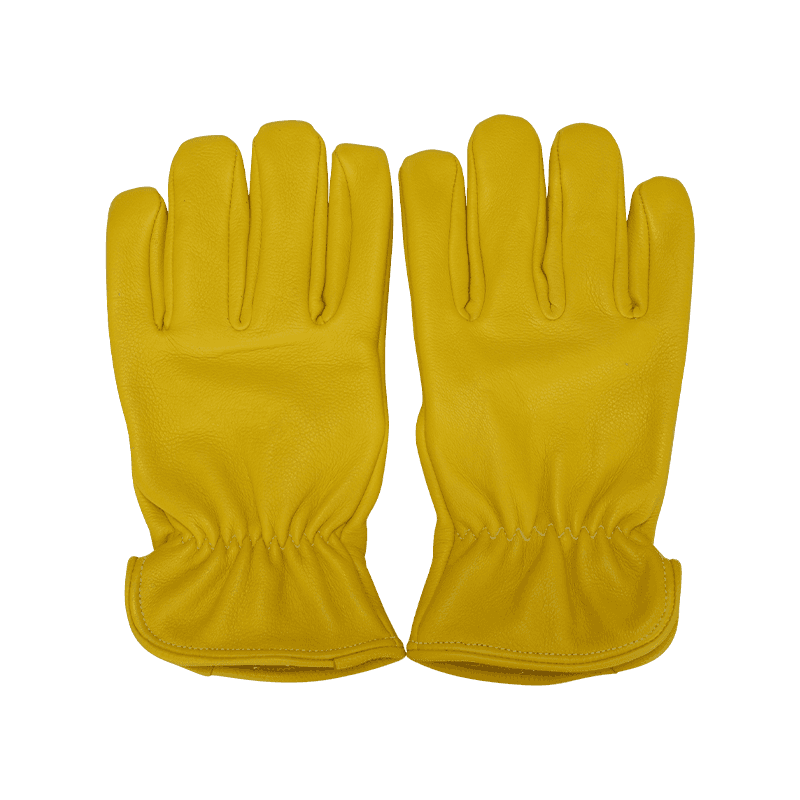 Cut-Resistant Cowhide Leather Work GlovesErgonomically fitted cowhide gloves with a breathable cut-resistant lining for comfort during long wear. A versatile choice for buyers building a leather cut-resistant program across multiple hide options.View Product →
The third and fastest-growing group is the hybrid: a leather shell carrying an aramid or UHMWPE liner, which lifts the cut score while keeping leather's abrasion and heat advantages. From the same construction logic come the multi-hazard designs that dominate modern specifications, where a single glove is asked to be anti-impact and cut resistant, or waterproof, oil-resistant and cold-resistant at the same time. Those combinations are exactly what the next section sorts out.
Cut hazards rarely arrive alone. A worker who handles sharp stock may also be struck by falling parts, work outdoors in winter, dip a hand into oily machinery, or move between cold stores and hot welding bays in the same shift. Specifying a glove that solves only the cut problem, while ignoring the second and third hazard, is the most common selection mistake we see in buyer inquiries. The configuration cards below summarize the combinations that appear most often in industrial procurement.
Cut only
Classic cowhide cut resistant gloves for general handling of sheet metal, glass offcuts, recycling and packaging, where the edge is the only hazard.
Cut plus impact
Padded knuckle and finger protection over a cut-resistant shell, for stamping presses, oil fields, mining support and heavy part handling.
Cut plus cold
Insulated linings under cut-resistant leather for winter yards, cold stores and outdoor maintenance, where stiff cold hands lose grip.
Cut plus water and oil
Water-repellent and oil-resistant treated leather palms that keep grip in wet machining, marine and oily assembly environments.
Cut plus heat and flame
Flame-retardant treated leather and extended cuffs for welding support, foundries and hot workshops with sharp edges present.
| Work scenario | Dominant hazards | What to specify |
|---|---|---|
| Metal stamping and sheet-metal handling | Sharp burrs, impact from heavy parts | Cowhide or goatskin shell with anti-impact padding, aramid-reinforced palm, target A4 to A5 |
| Glass, sheet plastic and blade rooms | Very high cut risk, need for feel | Thin high-performance liner under a leather palm, snug fit, target A5 to A6 |
| Forestry and chainsaw operations | Chain laceration, impact, cold weather | Dedicated chainsaw protective layer, gauntlet cuff, warm lining |
| Wet, oily or cold outdoor work | Slips, cuts, oil, low temperature | Water- and oil-resistant treated leather, insulated back, textured palm |
| Welding support and hot work nearby | Sparks, flame contact, sharp edges | Flame-retardant treated leather, extended cuff, heat-tolerant stitching |
Forestry deserves a special note because it is the one area where ordinary cut ratings do not apply. A chainsaw does not slice the way a knife does; it tears through material at high chain speed, so protective chainsaw gloves use dedicated layers of fibers designed to clog and stall the running chain rather than merely resist a blade. Our cowhide chainsaw work gloves are built around that principle, and they pair the protective insert with a long gauntlet cuff because most chain contacts occur on the back of the hand and forearm.
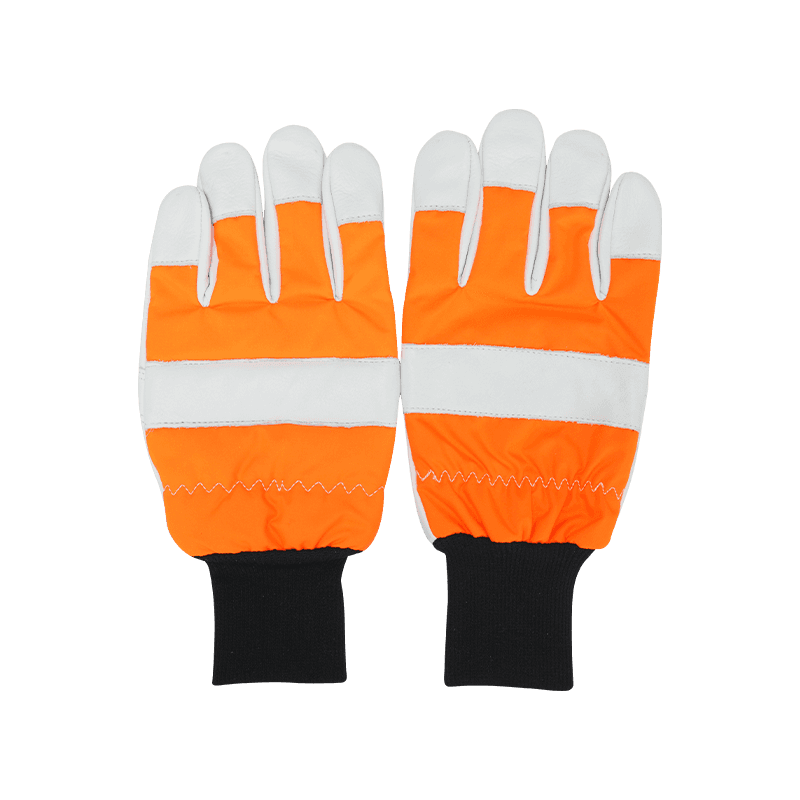 Cowhide Leather Chainsaw Cut-Resistant Work GlovesBuilt with protective fiber layers designed to clog and stall a running chain, plus a long gauntlet cuff. Suited to forestry work where chainsaw hazards differ from ordinary cut risks.View Product →
On metal fabricating floors, the second hazard after the edge is usually the impact of the part itself. Oil and gas crews, mining support teams and press shops therefore ask for impact pads across the knuckles and fingers on top of the cut-resistant build, and goatskin is often chosen at this point because it stays supple through repeated flexing while carrying the added padding. The combination of anti-impact protection and cut resistance in one leather glove removes the temptation for workers to swap gloves mid-task, which is when most accidents happen.
 Anti-Impact Cut-Resistant Goatskin Leather GlovesGoatskin gloves combining cut resistance with impact padding across knuckles and fingers, staying supple through repeated flexing. Ideal for metal fabricating, oil and gas, mining and press shop tasks.View Product →
Two warnings apply across every scenario. First, cut resistant gloves are not suitable for work near rotating, caught-in machinery such as drills and lathes, where any glove increases entanglement risk. Second, fit is a safety feature: a glove too loose catches on edges and reduces control, while a glove too tight fatigues the hand and encourages workers to remove it.
Buying a trial pair of gloves is simple; committing to a container load is a different exercise, because quality variance, documentation and logistics all multiply with volume. Whether you are a distributor building a private-label line or a safety manager consolidating suppliers, the checklist below covers the questions that decide whether a bulk order of cut resistant work gloves performs as promised.
The deepest difference in this market is not price but origin: a direct factory controls material selection, pattern making and quality inspection in-house, while a trader adds a margin and a layer of communication that can blur accountability. When you audit or interview a prospective cut resistant gloves manufacturer, ask to see the cutting and sewing lines, the inspection stations, the equipment list and the way test reports are archived against batch numbers. As a leather work glove manufacturer and supplier exporting worldwide since 1988, we built our production from OEM programs for international brands, which means customer specifications, confidentiality and repeat-order reliability sit at the center of how we work.
For wholesalers and importers, three commercial points deserve extra attention. Confirm that the factory can hold your specifications stable across seasons, since hide quality and liner sourcing vary if the supplier is not disciplined. Confirm who owns the tooling and patterns for your private-label models, so you can scale without renegotiating from zero. And confirm the logistics route: a plant near a major port, as ours is near Shanghai, shortens the distance between final inspection and vessel loading, which quietly protects your delivery dates.
How long a pair of cut resistant gloves lasts depends on the abrasiveness of the work, the hours per day of use, and how the gloves are treated between shifts. Leather gloves in heavy fabrication may be retired after weeks, while the same construction in light assembly work can serve for months. The care rules below apply to nearly every leather and lined glove in an industrial program.
Contamination is a quiet performance killer. Oil-soaked palms lose grip on sharp stock, which drives workers to squeeze harder and increases the chance of slippage into the blade, and heavy sweat exposure weakens leather fibers over time. Where cleaning is possible, follow the manufacturer's instructions at moderate temperatures, and treat a glove that no longer cleans up as a glove to replace. A simple visual standard posted at the glove dispensary - what a serviceable glove looks like versus a retired one - removes most of the debate from day-to-day decisions.
The questions below come up repeatedly in inquiries from distributors, safety engineers and purchasing teams. If your question is not covered, our team answers technical and commercial questions directly by email.
What cut level do I need for handling sheet metal?For typical stamping and sheet-metal handling, A4 to A5 under ANSI/ISEA 105, or the equivalent TDM letters in EN 388, is the working range most factories specify. Lighter offcut handling can sit at A2 to A3, while glass and very sharp blade rooms justify A6 and above. Match the level to the sharpest edge your workers touch daily, then verify with a line trial. |
Are leather gloves really cut resistant?Leather on its own provides moderate cut resistance together with excellent abrasion resistance, and it performs far better than cotton or ordinary synthetics against sharp edges. When the same leather shell carries an aramid liner and high-strength stitching, the cut score rises substantially while the leather keeps its grip, spark tolerance and durability. That combination is why cut resistant leather gloves remain the standard in heavy industry. |
Will a cut resistant glove protect against a chainsaw?Not reliably. A chainsaw tears rather than slices, so protection requires dedicated layers of fibers designed to clog and stall the moving chain, which is a different engineering problem from knife cut resistance. For forestry and saw work, specify purpose-built chainsaw gloves with a protective insert and a gauntlet cuff, and never substitute a high knife-cut rating for chain protection. |
Do thicker gloves always protect better?No. Thickness helps against abrasion and heat, but cut performance comes from fiber strength and construction, and an oversized thick glove can actually raise risk by reducing grip and control. A correctly fitted glove with the right liner reaches higher tested cut scores than many thicker unlined products, and workers will actually keep it on. |
How often should cut resistant gloves be replaced?There is no universal expiry date; replacement is driven by inspection, not the calendar. Replace any glove with a through-cut, a torn seam, a worn-through palm or permanent oil contamination, and set a routine cycle based on your duty cycle - daily inspection with weekly to monthly rotation is common in heavy use. Tracking retirement reasons over a month tells you whether the issue is the glove model or the task. |
Can I order cut resistant gloves with custom features or my own brand?Yes. As an OEM-experienced factory, we routinely adjust leather type, lining, cuff length and functional treatments, and apply customer logos, packaging and carton marking for private-label programs. Minimum order quantities and lead times depend on the model and the level of customization, so send your specification and target volumes for a tailored quotation. |
If you are building a glove program or comparing specifications, the resources below go deeper into materials, safety practices and our product range. Each link leads to further reading on this site.
For buyers, wholesalers and OEM partners who need a specification reviewed, samples arranged or a quotation prepared, contact us with your target cut level, work environment and expected volumes, and our team will reply with a professional recommendation.


If you are interested in our products, please consult us
 +86-0513-68163373