


 English
 Français
What Is an Heat Protection Glove Used For?
Content
- 1 What Is an Aluminized Aramid Heat Protection Glove?
- 2 What Is Aluminized Aramid Material and How Is It Made?
- 3 How Heat Reflection Technology Works in Protective Gloves
- 4 Temperature Resistance Comparison Across Glove Types
- 5 Key Application Environments: Where These Gloves Are Required
- 6 Performance Advantages Over Leather and Cotton Gloves
- 7 3D Structural Overview: Anatomy of an Aluminized Aramid Glove
- 8 Buying Guide for Industrial Procurement Teams
- 9 About Nantong Qiji Glove Co., Ltd.
- 10 Frequently Asked Questions
What Is an Aluminized Aramid Heat Protection Glove?
An aluminized aramid heat protection glove is a specialized industrial hand protection product designed to shield workers from radiant heat, open flames, molten metal splashes, and extreme temperature environments. These gloves combine two core protective technologies: an outer aluminized reflective layer that deflects radiant heat, and an inner aramid fiber substrate that resists ignition and retains structural integrity at elevated temperatures. The result is a glove capable of protecting hands in environments where temperatures routinely exceed 400 degrees Celsius, making them indispensable in foundry, steel plant, furnace, casting, and welding operations.
Unlike standard leather or cotton work gloves, aluminized aramid gloves reflect up to 95% of radiant heat away from the hand surface. This reflective capability is critical in steel mills and glass manufacturing plants where workers face intense radiant exposure even without direct contact with hot materials. The aramid fiber layer simultaneously provides cut resistance, abrasion resistance, and a degree of dexterity that purely metallic or ceramic protective equipment cannot offer. Industrial buyers sourcing from an aluminized aramid gloves supplier should evaluate both the reflective coating durability and the aramid grade used in construction.
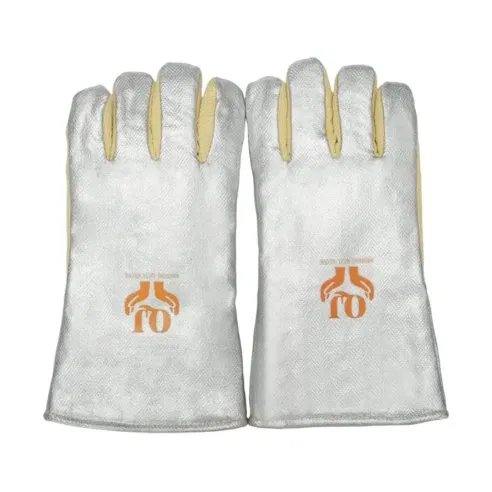
Aluminized Aramid Heat Protection Gloves - reflective outer layer with aramid thermal lining
What Is Aluminized Aramid Material and How Is It Made?
Aluminized aramid is a composite technical textile formed by vacuum-depositing or laminating a thin layer of aluminum film onto an aramid fiber base fabric. Aramid fibers - commercially known by chemical names such as para-aramid and meta-aramid - are synthetic polyamide polymers in which at least 85% of amide linkages are attached directly to two aromatic rings. This molecular architecture grants aramid fibers exceptional thermal stability, with decomposition temperatures beginning only above 370 degrees Celsius for meta-aramid variants and above 450 degrees Celsius for para-aramid constructions. The United States National Institute of Standards and Technology has documented aramid fiber behavior under thermal loading in multiple published reports, confirming sustained structural integrity at temperatures that would degrade polyester or nylon textiles within seconds.
The aluminum layer applied to the surface serves as a radiant heat mirror. Polished aluminum has an emissivity value of approximately 0.03 to 0.09, meaning it reflects 91% to 97% of incident radiant energy rather than absorbing it. When used on gloves for furnace heat resistant gloves applications, this coating dramatically reduces the thermal load that must be managed by the underlying fiber structure. Manufacturing quality of the aluminized layer is critical: delamination or cracking of the reflective film exposes the aramid substrate and reduces protection. Reputable industrial heat resistant aramid gloves factory operations test coating adhesion according to EN 407 or equivalent standards before shipping.
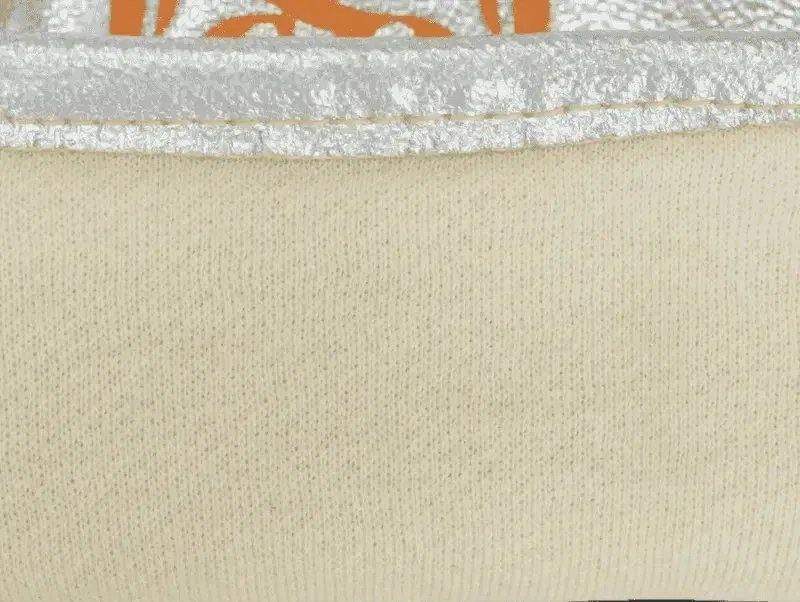
Close-up of the aramid thermal inner lining - dense fiber structure provides insulation and cut resistance
How Heat Reflection Technology Works in Protective Gloves
Radiant heat transfer follows the Stefan-Boltzmann law: energy emitted by a hot body scales with the fourth power of absolute temperature. At the temperatures present near a steel furnace or casting mold - often between 700 and 1,600 degrees Celsius - radiant flux is enormous. A bare human hand cannot tolerate even brief exposure at these distances. The aluminized outer layer of heat reflective aramid gloves intercepts this radiation and reflects it back toward the source rather than allowing it to penetrate inward. The physics are identical to a space blanket or a thermos flask lining, scaled to an industrial hand protection application.
Underneath the reflective film, the aramid thermal gloves structure provides conductive and convective insulation. Air pockets trapped between fiber layers slow the transfer of heat through direct contact or hot-air convection. The thickness of the aramid padding layer is therefore directly correlated with contact heat protection: thicker construction raises the time-to-pain threshold and the time-to-injury threshold specified in EN 407 standard test methods. For most furnace and foundry applications, a minimum glove weight of 350 grams per pair and an aramid padding thickness of at least 4 mm is recommended by industrial hygiene practitioners.
This bar chart compares the radiant heat reflectivity of different hand protection materials measured under standardized radiant heat exposure conditions. Aluminized aramid gloves achieve approximately 95% radiant heat reflectivity, the highest of any commercially available glove material, owing to the vacuum-deposited aluminum surface film. Aluminized fiberglass reaches around 88%, offering comparable radiant protection but with reduced flexibility and dexterity. Leather gloves reflect only about 12% of incident radiant heat, primarily through surface absorption and limited re-emission. Cotton gloves provide virtually no radiant protection at approximately 6%, making them entirely unsuitable for high-radiance industrial environments such as steel furnaces or casting floors. The data reinforces why procurement teams at foundries and steel plants consistently specify aluminized heat protection gloves over conventional materials when workers face sustained radiant exposure.
Temperature Resistance Comparison Across Glove Types
Selecting the correct glove for a temperature environment requires understanding both the contact heat resistance and the radiant heat resistance of different materials. The EN 407:2020 standard defines six thermal performance levels covering flammability, contact heat, convective heat, radiant heat, molten metal small splash, and molten metal large splash. An industrial high temperature aramid glove targeting furnace or foundry applications should achieve at minimum Level 3 or Level 4 on contact and radiant heat performance under EN 407 testing.
| Glove Type | Max Continuous Use Temp. | EN 407 Radiant Heat Level | EN 407 Contact Heat Level | Suitable for Furnace/Foundry |
|---|---|---|---|---|
| Aluminized Aramid | 400 - 1000 deg C (radiant) | Level 4 | Level 3 - 4 | Yes |
| Aluminized Fiberglass | 500 - 1200 deg C (radiant) | Level 4 | Level 2 - 3 | Yes (limited dexterity) |
| Leather (Split Cowhide) | Up to 150 deg C | Level 1 - 2 | Level 2 | No |
| Cotton Canvas | Up to 80 deg C | Level 1 | Level 1 | No |
| Silicone Oven Glove | Up to 230 deg C | Level 1 | Level 3 | No |
This line chart illustrates how the time-to-pain threshold - the duration a gloved hand can be exposed to radiant heat before the wearer feels pain - declines as source temperature increases, comparing aluminized aramid gloves against conventional leather gloves. At 400 degrees Celsius radiant exposure, aluminized aramid construction provides approximately 38 seconds of protection, giving workers sufficient time to complete a handling task and withdraw safely, while leather gloves offer only about 12 seconds before pain onset signals thermal injury risk. As temperatures rise to 800 degrees Celsius, a scenario common near open induction furnaces or ladle pouring operations, heat resistant aramid gloves still maintain approximately 20 seconds of usable protection while leather becomes effectively non-protective. At 1,000 degrees Celsius and above, only aluminized reflective construction provides any meaningful protection interval - leather gloves provide no useful protection buffer at these temperatures. These data underline why industrial heat resistant aramid gloves are the mandatory PPE specification in steel, foundry, and glass industries globally.
Key Application Environments: Where These Gloves Are Required
Aluminized aramid heat protection gloves are specified across a range of heavy industrial environments. Understanding the specific hazard profile of each application helps procurement managers match the correct glove specification to the risk level present.
Foundry and Steel Plant Operations
In foundry and steel plant environments, workers are exposed to radiant heat from molten metal at temperatures between 1,200 and 1,600 degrees Celsius, as well as splashes of liquid metal during pouring and tapping operations. Aluminized aramid gloves wholesale procurement for these facilities typically prioritizes EN 407 Level 4 radiant performance and at minimum Level 3 contact heat resistance. The gloves must also resist puncture and abrasion from rough casting surfaces and slag particles. Many steel plants require gauntlet-style cuff lengths of at least 35 cm to protect the wrist and forearm.
Glass Manufacturing and Processing
Glass furnaces operate at temperatures between 1,000 and 1,600 degrees Celsius, and workers handling glass gobs, molds, or finished products in hot zones face both radiant and contact thermal hazards. Furnace heat resistant gloves used in glass plants must balance high radiant reflectivity with enough dexterity to manipulate glass tools safely. Aluminized aramid constructions are preferred because they allow finer grip than fiberglass alternatives while maintaining comparable reflective performance.
Welding and Metal Fabrication
Aramid welding heat gloves protect against the combined hazards of electric arc radiation, weld spatter, and contact with hot workpieces. MIG, TIG, and plasma cutting operations generate UV and infrared radiation at intensities that can cause skin burns within seconds of unprotected exposure. Welding-specific variants of aluminized aramid protective work gloves often incorporate a split-leather palm patch for additional abrasion resistance when gripping heavy components, while retaining the aluminized back for radiant protection.
Casting and Forging Operations
Die casting, investment casting, and hot forging all require workers to handle heated molds, dies, and billets. Temperatures of workpieces exiting furnaces in forging operations typically range from 900 to 1,200 degrees Celsius. Industrial high temperature aramid gloves selected for these environments should demonstrate a minimum contact heat performance of 250 degrees Celsius for a contact time of 15 seconds per EN 407 Level 4 definitions, ensuring the brief contact inherent in part handling tasks does not result in burns.
Performance Advantages Over Leather and Cotton Gloves
Industrial buyers often evaluate aluminized aramid gloves against more familiar leather or cotton alternatives. The following comparison illustrates why the performance differential justifies the higher initial investment.
This radar diagram compares five critical performance dimensions across three glove types used in industrial thermal protection applications. Aluminized aramid gloves dominate the radiant heat and contact heat axes, reflecting their engineered purpose of protecting against high-intensity thermal environments; no other common glove material comes close on these two dimensions. Leather gloves perform moderately on dexterity and durability but are severely deficient on radiant heat protection, making them a risk factor rather than a safeguard in high-radiance environments. Cotton gloves score highest on dexterity - they are light and easy to wear - but this advantage is irrelevant when thermal protection is the primary requirement, as cotton provides virtually no defense against contact or radiant heat above 80 degrees Celsius. Cut resistance and durability performance of aramid thermal gloves is also markedly superior to cotton, since aramid fibers have a tensile strength approximately five times that of steel on a weight-for-weight basis, per published data from fiber manufacturers. Overall, the radar visualization confirms that aluminized aramid protective work gloves represent the only viable choice when multiple thermal hazard dimensions must be addressed simultaneously.
3D Structural Overview: Anatomy of an Aluminized Aramid Glove
Understanding the layered construction of a heat resistant aramid glove helps buyers assess quality specifications and compare offerings from different suppliers. The following isometric SVG diagram illustrates the principal structural zones of a gauntlet-style aluminized aramid work glove.
This structural cross-section diagram illustrates the four-layer architecture common to quality aluminized aramid heat protection gloves. The outermost aluminized film is the primary defense against radiant heat, reflecting 90 to 95 percent of incident thermal radiation. The aramid fiber substrate beneath provides the structural backbone of the glove, resisting cut, abrasion, and puncture hazards while maintaining integrity at temperatures that would destroy conventional textiles. A thermal padding layer, typically composed of additional aramid or para-aramid batting, acts as a conductive insulation buffer, slowing the transfer of heat from the outside surface to the hand. The innermost comfort lining, commonly a cotton or terry weave, manages moisture and prevents skin irritation during extended wear periods. The extended gauntlet cuff, which should measure at least 35 cm from fingertip to cuff edge on furnace and casting applications, ensures the wrist and lower forearm receive the same level of protection as the hand.
Product side view showing the gauntlet cuff and layered construction
Buying Guide for Industrial Procurement Teams
When sourcing aluminized aramid gloves wholesale or placing an OEM order with an industrial heat resistant gloves factory, procurement professionals should evaluate suppliers on the following criteria. A disciplined evaluation process reduces the risk of purchasing gloves that appear compliant but underperform in real industrial conditions.
- Certifications and Standards: Verify that the supplier can provide EN 407 or ANSI/ISEA 138 test reports from accredited third-party laboratories. Request specific performance level values for each EN 407 sub-test, not just a general pass claim.
- Aramid Fiber Grade: Confirm whether para-aramid or meta-aramid is used. Para-aramid offers higher tensile strength while meta-aramid offers higher continuous use temperature stability. Premium heat protection gloves factory offerings often specify fiber grade in their product documentation.
- Aluminized Layer Durability: Ask for data on coating adhesion after flexing cycles. A minimum of 2,000 flex cycles without visible delamination is a reasonable threshold for industrial service.
- Glove Weight and Thickness: Heavier gloves with thicker aramid padding provide better contact heat protection. For furnace and casting applications, a total glove weight of at least 350 grams per pair and aramid layer thickness of 4 mm is commonly specified.
- OEM and Customization Capability: Established high temperature gloves wholesale China manufacturers can accommodate custom sizing, logo embroidery, cuff length specifications, and packaging for private-label programs. Request sample production timelines and minimum order quantities before committing.
- Quality Management System: ISO 9001 certification indicates that the factory operates under documented quality procedures. Ask for the most recent audit report and corrective action records to assess the supplier's quality culture.
This horizontal bar chart summarizes the top procurement priority factors reported by industrial safety and purchasing managers when selecting an aluminized aramid gloves supplier. Certifications and standards compliance ranks highest at 92%, reflecting the regulatory and liability pressures that drive PPE procurement decisions in heavy industry. Verified thermal performance data - actual EN 407 sub-test scores from accredited labs - ranks second at 88%, confirming that buyers are increasingly sophisticated in distinguishing between genuine performance and unverified marketing claims. Durability, which directly impacts total cost of ownership by determining how frequently gloves must be replaced, ranks third at 78%. Fit and dexterity considerations rank at 65%, particularly relevant for welding and glass handling where hand mobility affects productivity. OEM flexibility, the ability to customize sizing, labeling, and packaging, ranks at 58% - an important factor for large distributors and safety equipment resellers sourcing heat protection gloves factory price programs. Lead time is ranked lowest at 45%, suggesting that buyers are willing to plan ahead and accept longer production timelines in exchange for quality assurance.
About Nantong Qiji Glove Co., Ltd.
Nantong Qiji Glove Co., Ltd. was founded in 1988 and is located in Rugao City, Jiangsu Province, China. The city is renowned internationally as a longevity destination with a pleasant natural environment and is situated in close proximity to Shanghai, providing highly convenient logistics and transportation access. The company occupies a facility of 12,000 square meters and employs between 168 and 200 workers, generating annual sales of nearly 100 million RMB. Qiji holds strong bank credit ratings and has been recognized as an outstanding local enterprise.
Adhering to the principles of integrity first, quality-oriented operations, and service excellence, Nantong Qiji Glove serves direct global customers and procurement professionals. The company began as an OEM manufacturer and has developed its own research, development, and production capabilities over more than three decades of operation. The product category has expanded from general labor protection gloves to encompass a comprehensive range of leather work gloves with specialized features including cut-resistant aramid gloves, anti-impact protection, high temperature resistance, waterproofing, oil resistance, fire resistance, and cold protection. The production facility is equipped with modern multi-functional machinery including electric sewing machines, ironing machines, chain-processing machines, bartack sewing machines, and various embroidery machines.
Nantong Qiji maintains a commitment to brand development and continuous product optimization. Products are exported to customers around the world, and the company has earned recognition from both domestic and international clients for consistent quality and responsive service. Buyers seeking a reliable aluminized aramid gloves supplier or exploring furnace protection gloves OEM programs are welcomed to contact Qiji for samples and production consultations.
Frequently Asked Questions
Q1: What is the maximum temperature that aluminized aramid gloves can protect against?
Aluminized aramid gloves can reflect radiant heat from sources up to approximately 1,000 to 1,200 degrees Celsius depending on construction quality and distance from the heat source. For direct contact heat, protection is rated up to 250 to 400 degrees Celsius on the contact surface per EN 407 Level 3 to Level 4 specifications. They are not designed for prolonged direct immersion in molten metal.
Q2: What certifications should I look for when buying heat resistant aramid gloves?
For international markets, look for EN 407:2020 certification for thermal risk protection and EN 388 for mechanical hazard performance. North American buyers should check for ANSI/ISEA 105 compliance. Request the actual laboratory test report with specific performance level values - not just a certification logo on the packaging - to confirm the gloves meet your specific application requirements.
Q3: Can aluminized aramid gloves be washed and reused?
Light surface cleaning with a damp cloth is acceptable for most aluminized aramid gloves. Machine washing or immersion cleaning is generally not recommended because it can damage the aluminized film adhesion and compress the thermal padding layer, reducing protection performance. Inspect the aluminized coating before each use: if delamination, cracking, or discoloration of the reflective layer is visible, the glove should be replaced.
Q4: What is the minimum order quantity for wholesale or OEM aluminized aramid gloves?
Minimum order quantities for wholesale aluminized aramid gloves from Chinese manufacturers typically range from 100 to 500 pairs per size per style for standard catalog products. OEM programs with custom specifications, branding, or non-standard sizing generally require higher minimums, commonly 500 to 1,000 pairs. Discuss your projected annual volume with the supplier early in negotiations as volume commitments typically influence unit pricing and lead times.
Q5: How do aramid welding heat gloves differ from standard welding gloves?
Standard welding gloves are typically made from split leather with a cotton or wool lining and offer moderate protection against weld spatter and short-duration contact heat up to around 200 degrees Celsius. Aramid welding heat gloves incorporate an aluminized outer layer over an aramid fiber substrate, dramatically increasing radiant heat protection and extending the safe working time near high-intensity arc and plasma cutting operations. They are preferred for heavy welding, cutting, and thermal spray applications where leather gloves would require replacement within a single shift.
Q6: Where can industrial buyers source aluminized aramid gloves directly from a factory in China?
Established manufacturers such as Nantong Qiji Glove Co., Ltd. supply aluminized aramid heat protection gloves directly to international buyers with OEM, private label, and standard catalog options. Buyers can verify factory credentials through the supplier's export records, ISO certifications, and third-party audit reports. Trade platforms and in-person factory audits remain the most reliable methods for qualifying a new industrial heat resistant gloves factory before placing large orders.
 +86-0513-68163373
Product Category
Related Products
If you are interested in our products, please consult us
Contact Details
- Address: No.99 West Dingxin Road, Dingyan Town, Rugao, Jiangsu, 226500, China
- Fax: +86-0513-88568360
- Tel: +86-0513-68163373
- Email: [email protected]
[email protected]
Products
Quick Link
News Center
Mobile terminal
